
- 4
Fluiidd: Edge AI that ‘sees’ inside industrial pipe networks
SCAN42, an industrial pipework monitoring solution developed by France-based start-up Fluiidd, leverages a technology developed at the CEA after the Fukushima nuclear disaster. The solution, which uses embedded AI to track fluid flows and detect anomalies in real time, helps predict equipment breakdowns and streamline maintenance. SCAN42 has been deployed in dairy plants and, in a project for Naval Group and the French Navy, on board a naval ship.
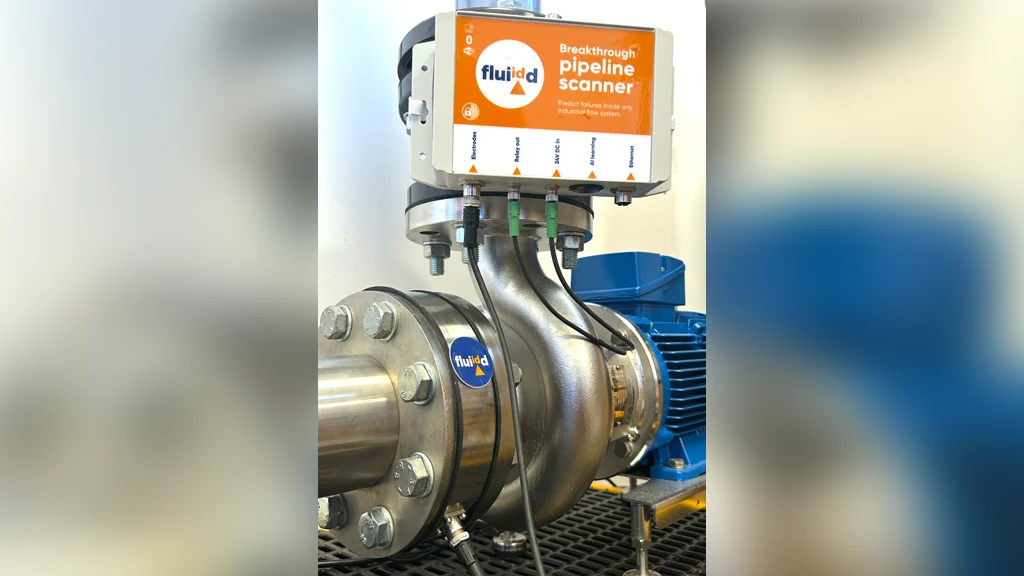
The SCAN42 embedded AI can interpret measurements and trigger an alert upon detection of an anomaly.
© Fluiidd
Air pockets in pipes, the onset of cavitation, and defects in cooling systems can all have serious consequences for industrial plants. France-based start-up Fluiidd has combined electrical impedance tomography and AI in a novel fluid-system monitoring solution called SCAN42 designed to detect problems in pipework before they cause equipment failures.
The technology inside SCAN42 was originally developed in response to the nuclear safety issues that arose after the Fukushima disaster in March 2011. Mathieu Darnajou, now CEO of Fluiidd, started working on the technology at the French Alternative Energies and Atomic Energy Commission (CEA) in 2014. His research resulted in a sensor capable of distinguishing between water and water vapour in nuclear plant pipework more accurately than existing technologies, with the goal of detecting certain overheating situations.
Developed over several years of research, the technology has proven to be a good match for non-nuclear use cases. “Our CEO Mathieu Damajou, originally a physicist, came up with the invention that sparked the whole idea behind the company,” said Fluiidd Marketing Director Arielle Cogniat.
Seeing inside pipework
SCAN42 is based on the principle of electrical impedance tomography. The sensor’s integrated electrodes send an electric current through the system and the impedance between different points is measured. The measurement data is then used to reconstruct an image of fluid distribution inside pipework and to identify variations characteristic of an abnormal flow. Specifically, SCAN42 can identify air pockets, cavitation, and other abnormalities that could result in damage to equipment.
Air pockets or bubbles, for example, can speed up wear and tear on mechanical parts in equipment like pumps.
Installing the sensor does require some work on the pipes. A section of pipe is replaced by the sensor unit, generally secured in place with flanges. Once installed, however, the sensor unit does not affect the flow of fluid within the pipe. “Although it is necessary to cut into the pipe to install the unit, the solution is non-intrusive in that the flow of fluid is not disrupted in any way during operation,” said Arielle Cogniat.
The ability to monitor pipework without altering operating conditions or affecting processes is something that is particularly important to manufacturers. SCAN42 addresses a wide range of industries, from chemicals, energy, and shipbuilding to agriculture, food manufacturing and cosmetics.
Edge AI predicts breakdowns
SCAN42 is more than just a sensor. The solution’s added value also resides in electronics with embedded AI that can interpret measurements and trigger an alert upon detection of an anomaly.
According to Fluiidd, the device captures around 32,000 measurements per second. The data is processed directly on the device using embedded AI, eliminating the need for third-party or cloud services. This Edge architecture means that data can still be processed, even in situations where security requirements or limited connectivity make communication outside the plant difficult. “Our embedded AI algorithms are where our product really adds value. A large amount of measurement data can be processed very rapidly without the need for third-party or cloud systems,” said Arielle Cogniat.
And SCAN42 is versatile, with customisable data processing to meet each customer’s needs. The sensor itself is compatible with a wide range of use cases, and the AI can be fine-tuned to identify specific anomalies or optimise a given process. “The sensor offers broad compatibility. It is the AI that enables us to tailor the solution,” she said. The software, one of the solution’s key differentiators, is managed by Fluiidd.
Alerts can be displayed locally or sent to the customer’s industrial information system via a PLC. For military applications, for example, users are likely to opt for local processing and alerts to avoid sending data outside the system. SCAN42 allows users to transition from reactive maintenance – repairing equipment after a problem occurs – to truly predictive maintenance. The solution picks up recurring or worsening anomalies so that action can be taken before equipment fails. For maritime applications, this means preventative maintenance can be planned for the next available opportunity, like the ship’s next call at port.
From dairy plants to naval ships, a field-tested solution
A dairy producer in North America has already implemented Fluiidd’s SCAN42 monitoring solution. SCAN42 is also being used to monitor a ship’s water pipes in a project for Naval Group and the French Navy, according to statements by Fluiidd. Details about the ship and the exact type of pipes being monitored were not provided.
Water pipes perform a variety of functions on ships, from carrying drinking and wastewater to supplying fire-fighting and cooling equipment. Faults can cause system downtime, complicating operations – especially when a ship is far from port.
Predictive maintenance is especially important in this type of scenario. “In naval and, especially, defence use cases, our technology can make a real difference in helping maintain operational readiness,” said Arielle Cogniat.
With SCAN42, technicians can identify drift from normal operating conditions and plan maintenance at the next appropriate time – before the problem develops into an equipment failure. Civilian ships, whose systems must remain operational for long periods at sea, can also benefit from these predictive maintenance capabilities. While SCAN42 was originally designed for nuclear and civilian use, it can be adapted to meet military requirements.
Keeping AI know-how in-house
As Fluiidd grows, one of the areas the company is focusing on is its ability to adapt to different industrial use cases. Each industrial environment comes with its own fluids, processes, and faults to detect. Fluiidd’s strategy is to continue to leverage the same sensor architecture, tailoring the software to each use case. The company, founded in 2023, currently has a team of ten people that includes researchers, engineers, and AI and embedded electronics experts. “We have physicists, embedded systems engineers, and everything in between,” said Arielle Cogniat.
The start-up’s solution monitors pipework. The real challenge, however, lies in translating physical measurement data into actionable information that is useful for operators. Whether it is in an industrial facility or on board a ship, detecting faults early can help limit damage to equipment and reduce downtime for better continuity of service. At Fluiidd, Edge AI’s role is to connect data, alerts, and maintenance decisions.
- Pascal Samama


