
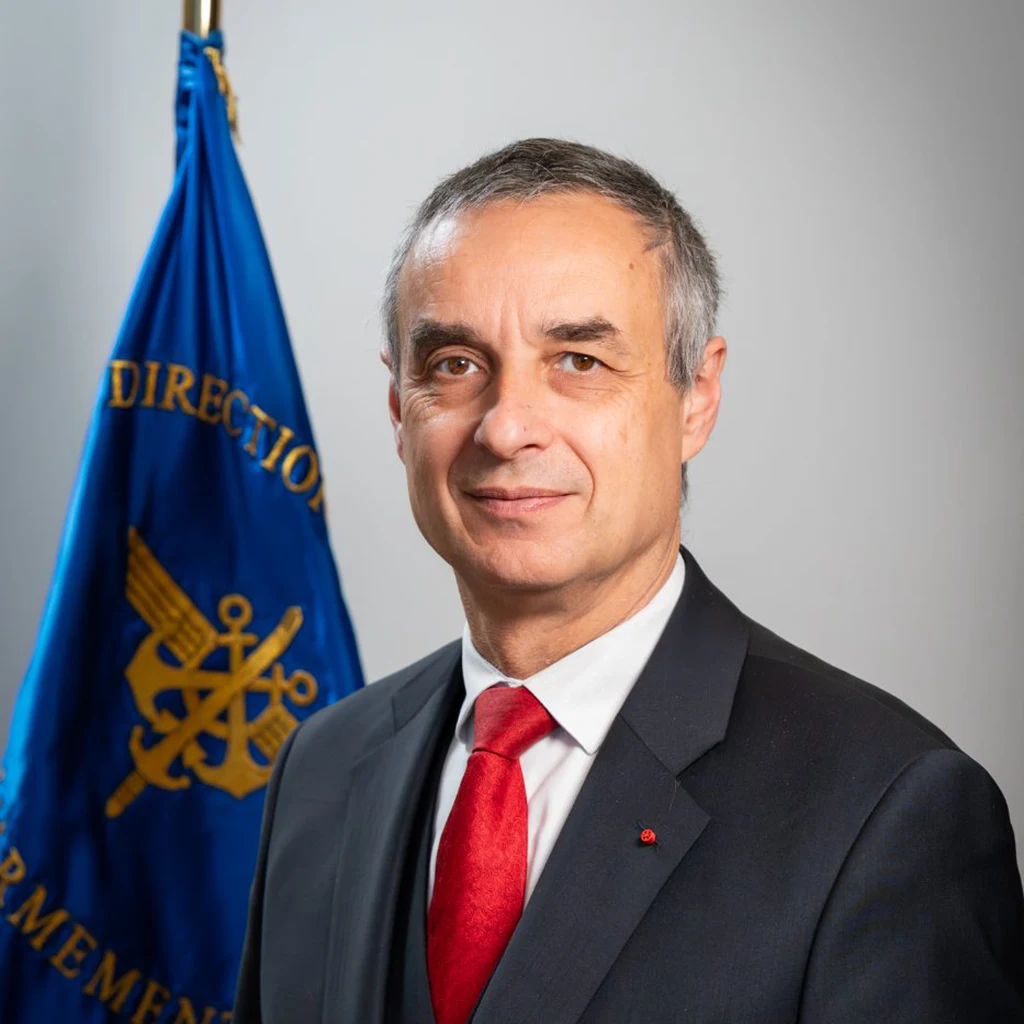
Three questions for Patrick Pailloux
Head of France’s DGA defence procurement and technology agency
This 30th edition of Euronaval is your first in your current position. What are the key challenges that the DGA faces between now and 2030?
Firstly, from a strategic perspective, naval warfare is undergoing profound changes: challenges to sovereign territories, hybrid threats, and the vulnerability of subsea infrastructure. For France, which has the world’s second-largest exclusive economic zone(EEZ), preserving our freedom of action at sea is a major challenge.
From a technological perspective, disruptive changes are accelerating: collaborative warfare, drones and C-UAS, electronic warfare, AI and cyber security. These developments require us to rethink our weapon systems and shorten development cycles.
This week, what we are seeing at Euronaval is that France possesses exceptional technical and industrial expertise in the naval field: aircraft carrier, nuclear submarines, defence and intervention frigates, and mine warfare systems. These foundational programmes are essential to our strategic autonomy.
This long-term expertise must now be complemented by the ability to accelerate, thanks in particular to the DGA’s Centres of Expertise, which bring together our experts and operational personnel in the field to rapidly develop, test and acquire solutions.
What disruptive innovations will equip the French Navy’s future vessels (third-generation SSBNs, FDI frigates, new-generation aircraft carrier)?
It is difficult to predict exactly what the warfare of tomorrow will look like, but future combat will evolve in step with two particularly transformative trends: the proliferation of drones and digitalisation.
The proliferation of drones expands operational capabilities by increasing the number of sensors and effectors: unmanned aerial, surface and underwater vehicles make it possible to extend surveillance, increase the number of detection points, explore the seabed and diversify operational capabilities, while minimising crew exposure. The challenge is not simply to add drones to the fleet, but to ensure they operate in concert with existing ships, aircraft and combat systems.
Digitalisation, for its part, connects systems to improve situational awareness and speed up decision-making: data is the key, and the DGA is working to fuse information from multiple sensors, drawing on open, interoperable and scalable digital architectures.
Today, the French Navy plays a vital role in safeguarding our sovereignty and freedom every day. Its SSBNs guarantee our second-strike capability in the event of a surprise attack. The Navy protects our maritime areas, both around mainland France and in our overseas territories, including our exclusive economic zone (EEZ), the second largest in the world. It defends our interests wherever they lie, with French ships deployed across the world’s oceans. The Navy also demonstrates our commitment to international law by sailing through the Taiwan Strait to uphold freedom of navigation. It contributes to European security in the Baltic and Mediterranean seas and strengthens our ability to act through partnerships with allied navies. In today’s interconnected world, where 90% of data travels through undersea cables, France depends on a Navy capable of operating far from home for extended periods, monitoring and taking action above, on and beneath the sea’s surface.
Dassault has just delivered a Rafale F5 to the DGA for testing. Will there be a naval version?
There will indeed be a naval version of the Rafale F5.
To date, the DGA Essais en Vol (EV) expertise and test centre has received its first Rafale ABE flying test bed (FTB), which will ultimately be used to test the future F5 standard.
This FTB is a heavily modified aircraft, equipped with measurement systems, data recordersand a data link to the ground-based test teams, enabling real-world testing of future aeronautical technologies: navigation and attack systems, sensors, weapons, communication systems and on-board software.
Delivered to the F4.1 standard, the Rafale ABE will undergo extensive modifications by experts from DGA EV, with the support of Dassault Aviation, in order to integrate test and measurement systems and thus attain the F5 standard.
The long-term future of our naval industry also depends on its ability to export. Greece’s order for a fourth FDI frigate, for example, has helped sustain production capacity across France’s naval industrial base. European cooperation therefore contributes to our sovereignty, and the ongoing discussions in Brussels on the EU’s future budget must give due priority to European preference in our industry.
- Aude Leroy


