
- 2
Egide adapts its C-UAS systems for ship protection
The French start-up is expanding its C-UAS systems into the naval sector. Its product line comprises two complementary effectors: Steropes, designed to neutralise small FPV drones, and Arges, for faster drones with a longer range. The company is investigating how to integrate the effectors onto naval vessels, to complement existing defence systems.
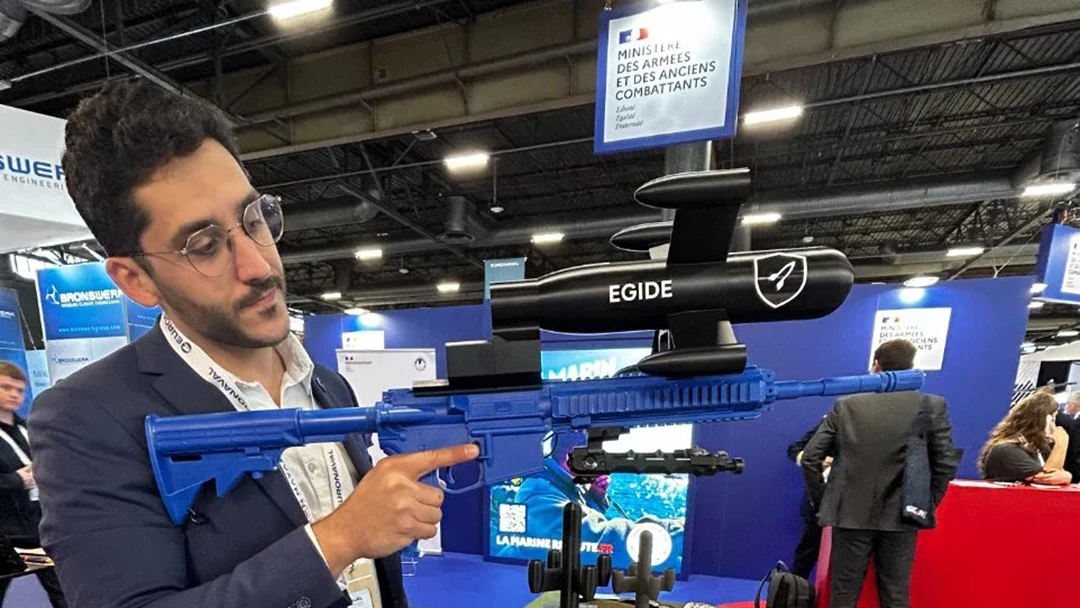
Florian Audigier, co-founder of Egide, shows the company’s Steropeseffector.
© Pascal Samama
Having established itself in land-based combat, Egide is adapting its C-UAS solutions for the naval sector. For its first appearance at a naval exhibition, the young French company is showcasing two effectors, Steropes and Arges, designed to intercept different types of drones. Their integration on board ships marks a new stage in the company’s development.
“The threat posed by drones no longer concerns only ground forces. Surface vessels and port infrastructure must also protect themselves against attacks carried out by light drones or longer-range systems,” explains Florian Audigier, co-founder of Egide.
Two effectors for two types of threat
Steropes is designed to neutralise small FPV drones used in theatres of operations. “Its operation is based on a simplified procedure: the operator points the system at the threat, locks onto the target and fires. The effector then autonomously heads towards the drone” says Audigier. The system can operate without radar or external electro-optical sensors.
Arges is designed for larger and faster threats, such as the Iranian Shahed attack drone or the Russian Geran drone. The company claims a detection range of up to 15km and an interception range of 10–15km, depending on the target’s speed. Its guidance system enables it to intercept a threat regardless of its direction of approach, without having to pursue it.
A complementary defence to missiles
Egide’s approach is to offer effectors that are less expensive than conventional surface-to-air or anti-ship missiles. They could thus complement existing defence systems by dealing with threats posed by drones, while reserving the more expensive missiles for more complex targets, such as aircraft, helicopters or ballistic missiles.
For the naval sector, the company is considering integration on board ships, notably by means of a container installed on the deck. The operating principle would be similar to that envisaged for land-based systems, with the option of connecting to the ship’s command system. However, further work is needed on the adaptation: space constraints and the availability of installation points on board complicate the integration process.
Founded in September 2025, Egide raised €8 million in March 2026. This funding round was led by Expeditions, Eurazeo and Heartcore Capital, with participation from Galion.exe and Kima Ventures. Following Eurosatory, Euronaval marks the company’s second appearance at a trade fair and its first exhibition in the naval sector.
- Pascal Samama


