
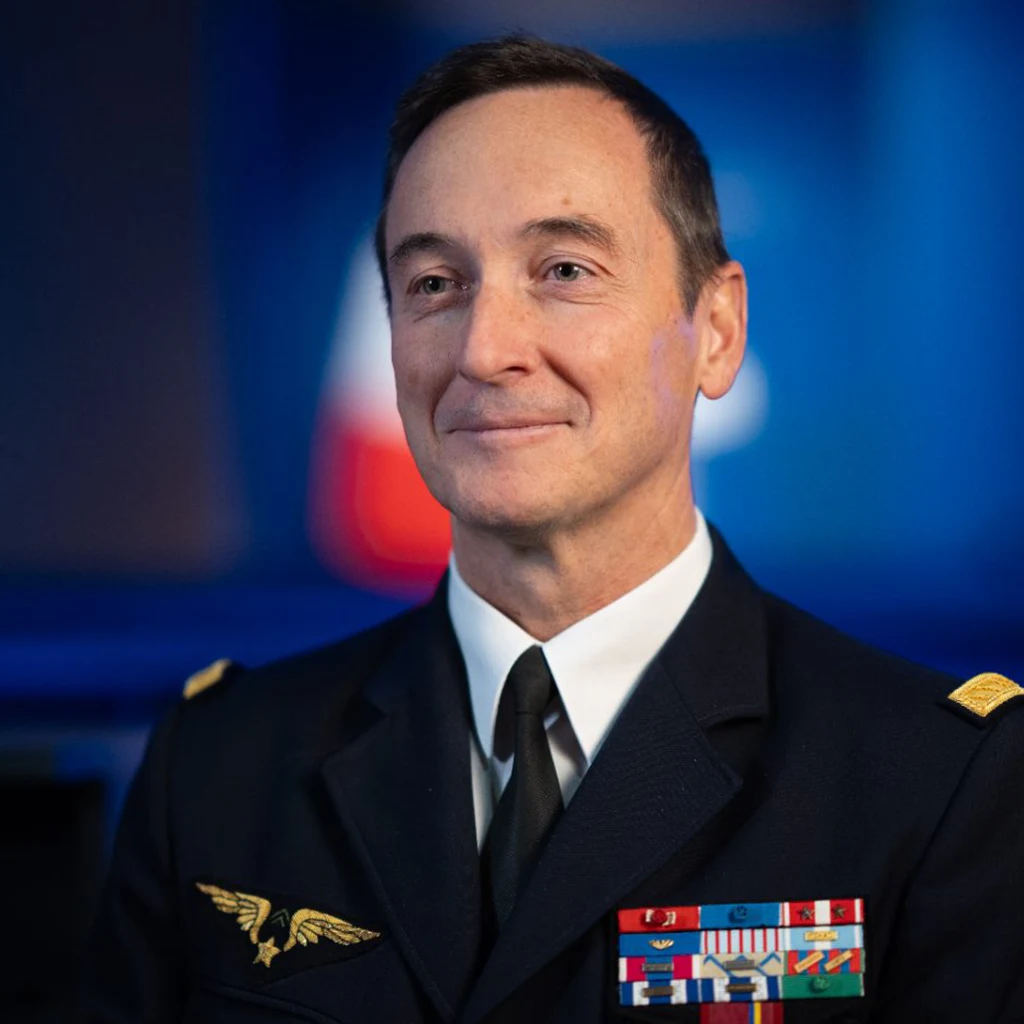
4 questions for General Fabien Mandon
Chief of Defence Staff
General, as France’s Chief of Defence Staff, how important is the maritime domain in your strategic thinking?
The maritime domain is of central strategic importance. The sea is a rich yet fragile environment, connecting continents and people through trade and exchange. But it has also become a source of confrontation and competition between powers seeking to assert their sovereignty. Our freedom of action, our ability to project power and our strategic credibility all depend on it. The maritime domain is also a vulnerable environment, where we need to protect underwater infrastructure and shipping routes. Control at sea is essential. The French Navy has just celebrated its 400th anniversary and is receiving significant investment to ensure that it can continue to defend our citizens, our sovereignty and our interests.
Euronaval is the largest international naval defence exhibition. How important is it today and for the years ahead?
Euronaval is much more than a showcase for technology. It is a strategic forum that brings together the armed forces and industry to shape the future of maritime power. Our future operational superiority is being built today in companies and research centres. Our requirements are demanding: we need to modernise our equipment and nuclear deterrent, counter the drone threat and master new technologies. Euronaval provides an ideal opportunity to ensure that industry’s capacity for innovation is aligned with operational requirements. I also expect to see industrial solutions that can be produced quickly, at low cost and in large quantities if necessary. This is a necessary shift, and one that our armed forces are calling for.
What do you see as the three main challenges facing the French Navy?
They are broadly similar to those facing the French armed forces as a whole. First, with the international situation deteriorating faster than anticipated, we need to accelerate the modernisation of our military capabilities, a process we began ten years ago. The second is to prepare for high-intensity conflict by building up our munitions stockpiles, accelerating the integration of drones into our capabilities and strengthening our operational preparedness. The third is to successfully complete our digital transformation, particularly through the integration of artificial intelligence, so that we retain our ability to analyse, decide and act faster than our adversaries.
Do you have a message for companies in the sector?
First, I want to express my confidence in them and recognise the expertise of our industry. It comes from dedicated men and women who are capable of what few countries in the world can do. But I also want them to understand that we must change and adapt to a rapidly evolving world.
The resilience of our armed forces depends on the resilience of the nation as a whole. We need a defence industry capable of rapidly ramping up production, supported by robust, sovereign supply chains in France and across Europe. We still need cutting-edge technology for our future warships, but we also have a vital need for less sophisticated capabilities that can be produced quickly, in large quantities and at an affordable cost. Open, interoperable and scalable information systems that can be rapidly adapted to operational realities will be essential. Together, we must build our capacity to produce, endure and innovate.
- Aude Leroy


