
- 3
C-UAS: RAPIDFire relies on STARNAV precision
To intercept a drone, the gun must fire exactly where the fire control system directs it to aim. To eliminate any discrepancy, Starnav is introducing Rapace, an optical system capable of measuring the gun’s alignment—without firing or using a laser—now adapted for the 40mm RapidFire system.
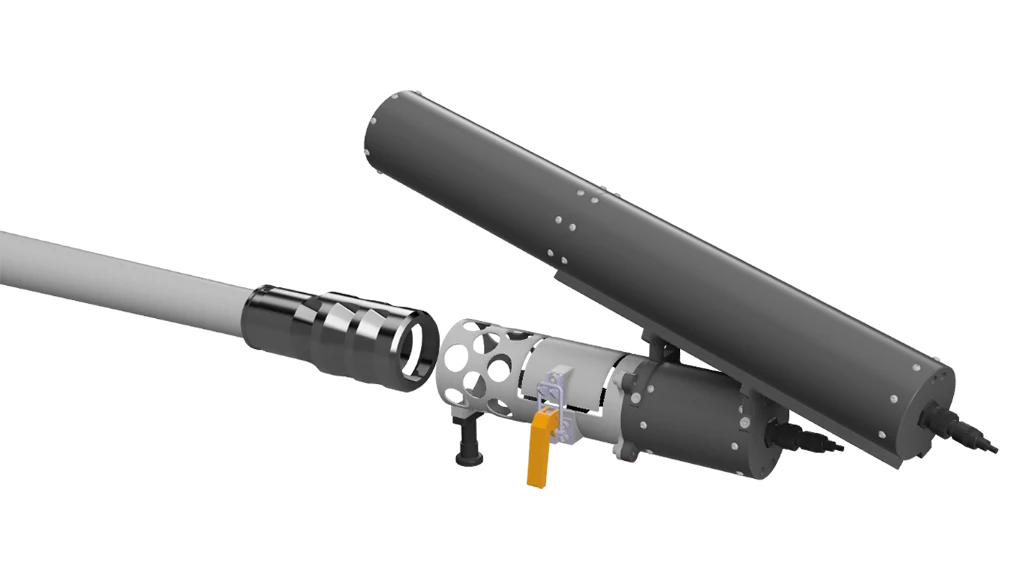
Rapace optically measures the alignment of the gun with the sight, without firing or using a laser.
© STARNAV
Even a slight misalignment can be enough to reduce the accuracy of a long-range shot. On a naval gun, designed in particular to counter drone-related threats, the problem is all the more critical, as the alignment between the gun and the sight can vary depending on the gun’s angle. This is the problem addressed by Rapace, an optical weapon-alignment device developed by the French SME Starnav, which specialises in precision technologies for weapon systems and navigation.
Originally developed for small-calibre weapons, Rapace is now available in versions up to 40mm. Its adaptation for RapidFire, a remotely operated naval artillery system developed by Thales and KNDS France, thus enables this technology to be applied to a larger-calibre weapon and to meet the specific constraints of the naval environment.
“To engage an aerial threat, the weapon must be able to aim at different altitudes: an alignment checked only horizontally does not cover the weapon’s full operational range. We seek to measure the actual deviation between the direction in which the gun is pointing and that indicated by the aiming reference, so that fire control can take this into account,” explains Georges Lamy au Rousseau, founder and managing director of Starnav.
Little margin for error
To do this, RAPACE uses two cameras: one measures the gun’s axis and the other that of the laser rangefinder, which serves as a reference for the sight, enabling the system to determine the deviations between the two axes without firing a shot and without projecting a laser beam towards an external target. The measurement can be carried out when the gun is pointing from 10° down to 70° up, including while the ship is at sea.
“If the adjustment is carried out solely in the horizontal plane, we cannot characterise the weapon’s behaviour when it is aimed at an aerial target. On the contrary, we want to measure these deviations across the entire elevation range relevant to its use,” declares Lamy au Rousseau.
The challenge is particularly acute in the context of C-UAS. A small aerial target leaves little margin for error and requires the full utilisation of the gun’s accuracy and fire control capabilities. Alignment must be controlled to take full advantage of the weapon system’s performance. This precision helps to make the gun a complementary defence alongside missiles and to preserve the latter for engagements where they are absolutely necessary.
Adjustments at sea
Beyond the measurement itself, the company highlights the possibility of carrying out these checks at sea, under the actual conditions in which the gun is used, particularly taking into account the ship’s movements and variations in elevation. “The benefit lies in being able to verify alignment in scenarios representative of the weapon’s operational use, rather than solely during onshore adjustments,” explains the Starnav executive.
This capability also addresses the issue of operational readiness, as, for navies, quickly identifying any discrepancy between the gun and the sight allows the weapon’s settings to be safeguarded before it is used, without the need for a test-firing sequence.
Starnav is already working on the next phase with Rapha, a system designed to harmonise the different channels of a sight: the day channel, used for observation under normal lighting conditions; the night channel, adapted for low-light situations; and the laser rangefinder, which measures the distance to the target. These different elements must be aligned to the same reference to guarantee the consistency of the entire optronic system.
The same principle applies to navigation
This quest for precision and autonomy is also evident in another solution presented by Starnav at Euronaval: Magellan, its astro-inertial navigation system, which is due to be integrated into a Naval Group demonstrator. Magellan uses the Sun and the stars to maintain navigation accuracy, even when GPS signals are jammed or spoofed. Overall, Starnav aims to provide weapon and navigation systems with independent and verifiable precision references as close as possible to operational conditions.
- Linda Verhaeghe


