
- 3
Ampera 3D-prints the world’s first nuclear reactor module, with defence and AI in its sights
A Florida-based start-up has unveiled a world first: a nuclear reactor module manufactured entirely using 3D printing. Behind this technical achievement lies an ambitious industrial strategy targeting AI data centres, defence and the maritime sector, underpinned by an AI-driven approach to nuclear safety that is likely to raise questions.
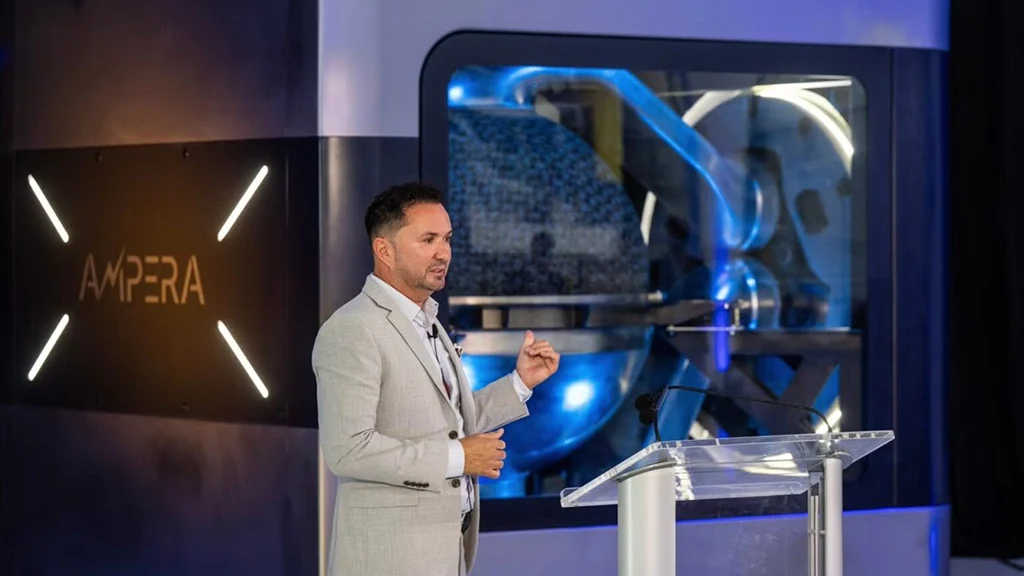
Brian Matthews, founder and CEO of Ampera, at the company’s innovation centre in Palm Beach Gardens for the unveiling of the first 3D-printed nuclear reactor module.
© Ampera
The module was unveiled on 1 July at Ampera’s innovation centre in Palm Beach Gardens, Florida, before an audience of more than 100 local officials, business leaders and company employees. Founder and CEO Brian Matthews personally revealed a fully 3D-printed silicon carbide sphere incorporating both the reactor core and its pressure vessel.
According to Matthews, the achievement lays the groundwork for factory-based mass production of nuclear reactors. He believes the additive manufacturing technology used provides a clear path to commercialisation, accelerating the introduction of new nuclear technology to the market.
An unprecedented technical design
Ampera is developing subcritical, thorium-based microreactor systems with high energy density that require no refuelling. The reactor core, a monolithic spherical gyroid structure, is 3D-printed from silicon carbide (SiC) and designed to operate for up to 30 years without refuelling. The fuel consists of thorium-based TRISO (tristructural isotropic) particles.
The choice of SiC is significant. This exceptionally robust ceramic can withstand temperatures of around 3,000°C without losing its properties. By comparison, conventional stainless steel begins to soften at 550°C and melts at around 1,400°C. Silicon carbide is also highly resistant to neutron irradiation, making it particularly suitable for nuclear applications. Until now, no one had succeeded in 3D-printing a nuclear component of this size from SiC, which is the basis for Ampera’s claim to a world first.
Another notable aspect of the manufacturing process is that the printer itself — a machine measuring approximately 3x3m and already being used to fulfil commercial orders — comes from a sister company founded by Brian Matthews. The company also manufactures industrial components for other sectors, including the maritime industry. Ampera sees this vertical integration as a major competitive advantage.
Passive safety complemented by embedded AI
Ampera places particular emphasis on passive safety, with the design and physical characteristics of the reactor core providing inherent protection and reducing reliance on active systems and human intervention.
But Ampera goes further with a concept known as Safeguards-by-Design. An embedded AI system monitors reactor parameters, manages alarms, tracks nuclear materials and recommends corrective actions in real time. Operators remain involved, but the need for human intervention is minimised.
To secure its supply chain, Ampera announced in June that it was establishing an Australian subsidiary to ensure a reliable supply of thorium and support the production of advanced nuclear fuel in the United States. The subsidiary handles extraction and initial transportation of the raw material, which Ampera then processes in-house through a localised supply network.
Ampera’s nuclear systems are expected to generate up to 30 MWe (megawatts electric), with larger configurations already planned.
A clear dual-use strategy
Brian Matthews said: “Our reactors are built for the markets that need power the most: AI data centres, defence, industrial and maritime.”
This focus on defence and maritime applications reflects a broader trend in the microreactor sector, where the prospect of high-density, transportable, modular power systems directly addresses the energy self-sufficiency needs of armed forces and naval platforms.
- Pascal Samama


