
- 2
Sonusia: A protective shield against underwater attacks
Sonusia, the latest innovation from Alseamar, creates a modular, passive underwater surveillance network designed to improve maritime safety and security in the face of growing threats both on and beneath the water’s surface.
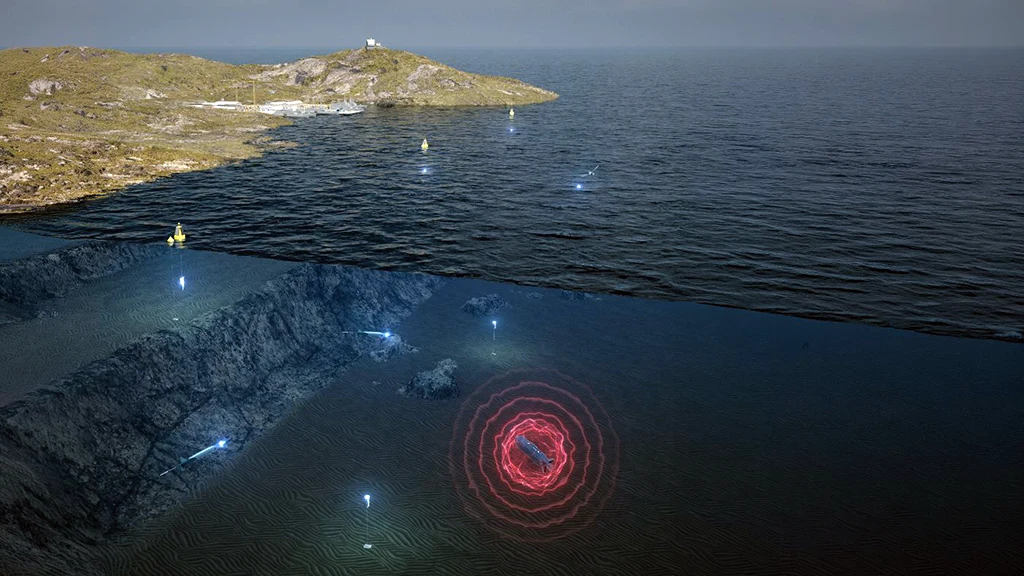
Sonusia
© Alseamar
From the Strait of Hormuz to major French ports and underwater gas pipelines in the Baltic Sea, maritime areas and critical infrastructure face threats ranging from terrorist attacks to illicit activities such as drug trafficking.
Sonusia uses a network of compact, discreet sensors to detect and identify underwater threats. Each one incorporates
Alseamar’s AURIS passive acoustic detection and processing system, already used by the French armed forces. Equipped with hydrophones, environmental sensors, an onboard computer and detection algorithms, AURIS processes acoustic and non-acoustic data in real time using edge computing, identifying anomalies such as approaching submarines, towed systems or underwater drones. The system can be deployed on mobile SeaExplorer underwater gliders, semi-mobile SeaMonitor buoys or autonomous SeaNode stations positioned on the seabed. The greater the number and density of these platforms, the more comprehensive the detection coverage across the protected area.
Discreet surveillance
Developed by Alseamar’s engineers at the initiative of company president Thibaud Bezacier, Sonusia combines several of the company’s existing technologies. “Two and a half years ago, I asked our engineers to combine our existing products to improve underwater security. To my knowledge, no other solution brings these capabilities together in quite the same way. We are seeing considerable demand, mainly from the defence sector, for solutions to protect ports, anchorages and infrastructure, including offshore wind turbine foundations and submarine cable landing sites. There is also interest in monitoring the movements of vessels and underwater objects in the Strait of Hormuz,” explains Thibaud Bezacier.
For example, the entrance to a port such as Toulon could be protected by an initial, concentrated deployment comprising around 30 underwater gliders, a similar number of buoys and a few autonomous stations. The surveillance network could then be extended further offshore.
The modular platforms transmit data to Alseamar’s proprietary command-and-control (C2) system, Glimpse, in real time via surface buoys and in near real time via SeaExplorer gliders. Glimpse then fuses and analyses the data processed on board.
“Sonusia has deliberately been designed with an open architecture, allowing other technologies, such as distributed acoustic sensing (DAS), to be integrated,” explains Thibaud Bezacier. [DAS uses laser pulses transmitted along an optical fibre to detect disturbances, editor’s note]. The system can be configured in countless ways, rather like Lego, with costs ranging from around ten million to several hundred million euros. Designed to be interoperable with NATO standards, among others, Sonusia is also attracting interest from civilian organisations, including law enforcement agencies working to combat drug trafficking in ports.
- Aude Leroy


