
- 3
Cerbair adapts its C-UAS systems for naval applications
At Euronaval 2026, Cerbair will showcase a naval version of its Hydra 300 drone detection system alongside its new compact Chimera 200. The French company is banking on a modular, industrialised approach to meet the C-UAS needs of naval vessels and offshore infrastructure.
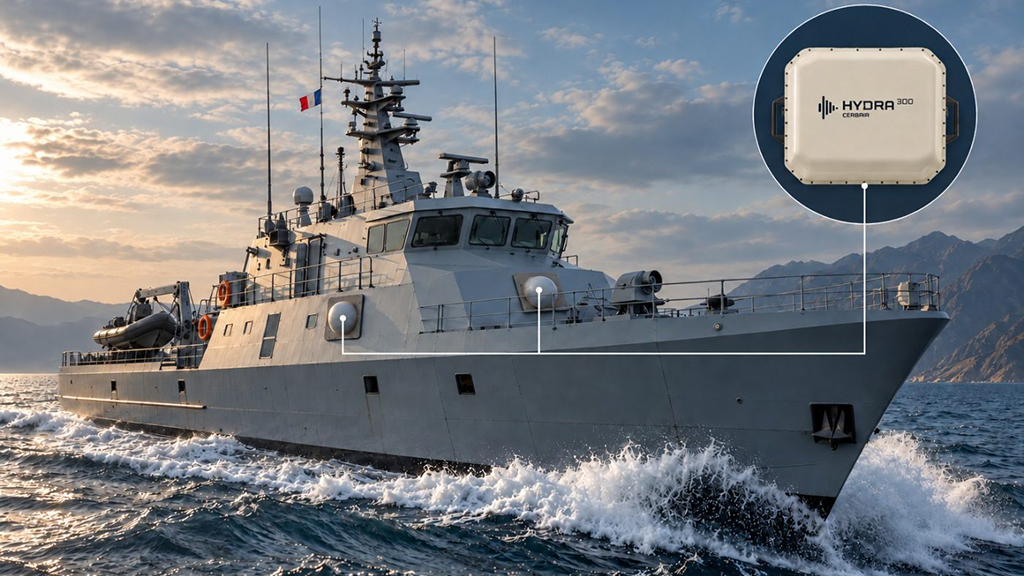
The Hydra family, a leading range of C-UAS systems, now includes a third version. The Hydra 300 has a detection range of 2 to 7km.
© Cerbair
Counter-drone operations are no longer confined to land-based environments. With drones increasingly operating around warships, ports and offshore energy infrastructure, there is now also a need for detection and jamming systems in the maritime domain. Cerbair is looking to expand its presence in this market, building on systems already in production for land-based applications.
One of the main new developments being showcased at Euronaval is the naval version of Cerbair’s Hydra 300 drone detection system. Rather than developing an entirely new detector, the company has adapted an existing model already in series production, giving it a significant industrial advantage.
“Sensors adapted for naval use typically require dedicated production lines, involving very high costs and equally long lead times. In our case, we can respond to a new requirement within just weeks or months,” explains Charlie Pinedo, Cerbair’s Chief Product and Strategy Officer.
The modifications mainly concern the system’s ability to withstand the marine environment, particularly in terms of mechanical robustness and corrosion resistance. The electronics, however, remain unchanged. Cerbair had already taken account of the specific electromagnetic constraints aboard warships when designing the land-based version, working in particular with experts from Naval Group.
This approach also allows the company to retain the support infrastructure established for the production volumes of its land-based systems, helping to keep the costs and lead times associated with the naval version down.
Applications beyond warships
Cerbair says it has already sold this version to a European navy, although it has not disclosed which one. Other projects are being developed in Asia. The company is also involved in a project to protect infrastructure in the Baltic Sea, particularly offshore wind farms.
Protecting offshore energy infrastructure represents another major opportunity for C-UAS technologies. Offshore wind farms, as well as oil and gas installations, may face drones used for surveillance, reconnaissance or malicious activities.
At Euronaval, Cerbair will also showcase the Chimera 200, a compact detection and jamming system. Designed primarily for installation on land vehicles, it can also be deployed aboard small boats. A demonstration is planned aboard a rigid inflatable boat (RIB). The Chimera 200 has also been integrated into a Sirehna unmanned surface vessel (USV).
A third system may also feature at the exhibition: the Medusa 300, a compact, high-power jammer designed in particular to complement the Hydra 300, providing a jamming capability once a drone has been detected.
Filling the gaps in electronic warfare capabilities
Cerbair is not, however, seeking to compete with the sophisticated electronic warfare systems fitted to major naval platforms. Instead, the company is positioning its solutions as complementary. “The aim is to address threats that do not necessarily justify deploying the most complex and expensive systems,” says Charlie Pinedo.
The idea is to reserve the most sophisticated electronic warfare capabilities for threats that genuinely require them, while using simpler systems to counter small drones. “It’s about filling the gaps and avoiding the use of a €30 million system when a €100,000 system can do the job,” explains the Cerbair executive.
This approach also relies on automated signal processing. The algorithms are designed to convert raw data into a tactical picture that users can interpret directly, without requiring an electronic warfare specialist to monitor and analyse the radio spectrum continuously.
A European industrial supply chain
On the industrial front, Cerbair retains control of its core technologies. Its Hydra systems are manufactured in France, while the Medusa systems are produced in Europe. On the Chimera 200, Cerbair is collaborating with an Indian company. The software and core technical expertise, however, remain French.
Cerbair favours a partnership-based model that draws on local expertise to gain access to certain markets, rather than replicating its entire industrial infrastructure in each country.
- Pascal Samama


