
- 3
MBDA unveils deep-strike missile with a range of more than 1,000km
Scheduled to enter service around 2030, the NCM-LCM Mk 2 is intended to strengthen the French Navy’s deep-strike capability, with a range of more than 1,000km, metric accuracy and improved resistance to jamming. This new version of the Naval Cruise Missile (NCM) will be deployable from frigates, submarines and land-based launchers.
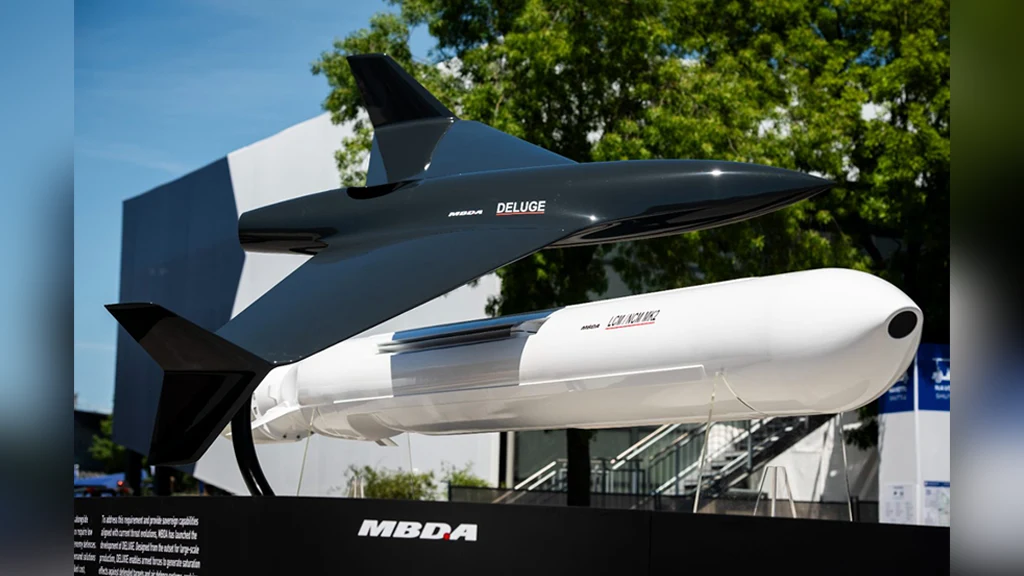
Open to European cooperation, the NCM-LCM Mk 2 is positioned as one of MBDA’s flagship innovations for 2026
© Jérémy LEMPIN / MBDA / 2026
The NCM-LCM Mk 2, which is being unveiled at Euronaval 2026, is the next generation of the French Naval Cruise Missile (NCM), already in service with the French Navy and combat-proven. Its aim is to enhance the Navy’s ability to operate at very long range in the most heavily contested environments. MBDA expects it to be available around 2030.
The NCM-LCM Mk 2 will offer greater resistance to jamming and improved survivability. It will feature a new-generation anti-jamming system for navigation in a degraded electromagnetic environment, as well as a reduced signature and improved flight performance to help it evade enemy defences.
One architecture for three platforms
Alongside these improvements, the missile offers a range of more than 1,000 km, stated metric accuracy and increased lethality. The programme is intended to evolve the NCM into a deep-strike capability better suited to the demands of high-intensity conflict.
One of the programme’s distinguishing features is its versatility. The missile is designed to be deployed from three types of platform: surface ships, submarines and land-based systems. The latter variant will be known as the Land Cruise Missile (LCM). MBDA expects the first land-based launch system, called the Ground Launch System, to be available from 2029. Its development builds on existing elements of the NCM launch system.
AI to accelerate mission planning
MBDA is also working to reduce mission-planning time. Its Fast Strike tool, which uses AI algorithms, is designed to simplify and speed up the preparation and coordination of strikes. It could be integrated into SCALP/Storm Shadow and NCM before 2030, making it easier to combine different types of missile.
The aim is also to combine different strike assets, pairing high-value missiles with massed capabilities. The NCM could therefore be used alongside the saturation capability offered by MBDA’s DELUGE one-way effector, increasing the resilience of the strike package.
The programme is being presented as open to European cooperation. By around 2030, the NCM-LCM Mk 2 is intended to be one of the major developments in MBDA’s cruise-missile family, combining platform versatility with an enhanced ability to operate in highly contested environments.
Stratus — a new European missile family
The result of cooperation between France, the UK and Italy, the Stratus programme comprises a family of two missiles intended to complement and eventually replace SCALP/Storm Shadow and Exocet. They will be compatible with naval and air platforms, including Mk 41 and SYLVER vertical launch systems (VLSs), as well as the Rafale and the future Global Combat Air Programme (GCAP).
The Stratus RS (Rapid Strike) will be a supersonic missile intended primarily for anti-ship, SEAD/DEAD (suppression and destruction of enemy air defences) and ground-attack missions, with a secondary capability against high-value airborne targets.
The Stratus LO (Low Observability) will prioritise stealth. It will be subsonic and feature a new turbofan engine developed by Safran Power Units and Rolls-Royce, together with a dual penetrator warhead for hardened targets.
The programme is based on cooperation and co-funding between the three countries, with the aim of delivering a new generation of European missiles combining speed, stealth and operational versatility.
- Pascal Samama


