
- 3
Camcopter S-300: Schiebel takes remotely piloted helicopters to a new level
Schiebel is taking another step forward in the development of remotely piloted systems. With the Camcopter S-300, the world leader in unmanned helicopters is offering a platform that can fly further and stay airborne for longer, without compromising on the equipment it can carry or the reliability for which the company is renowned.
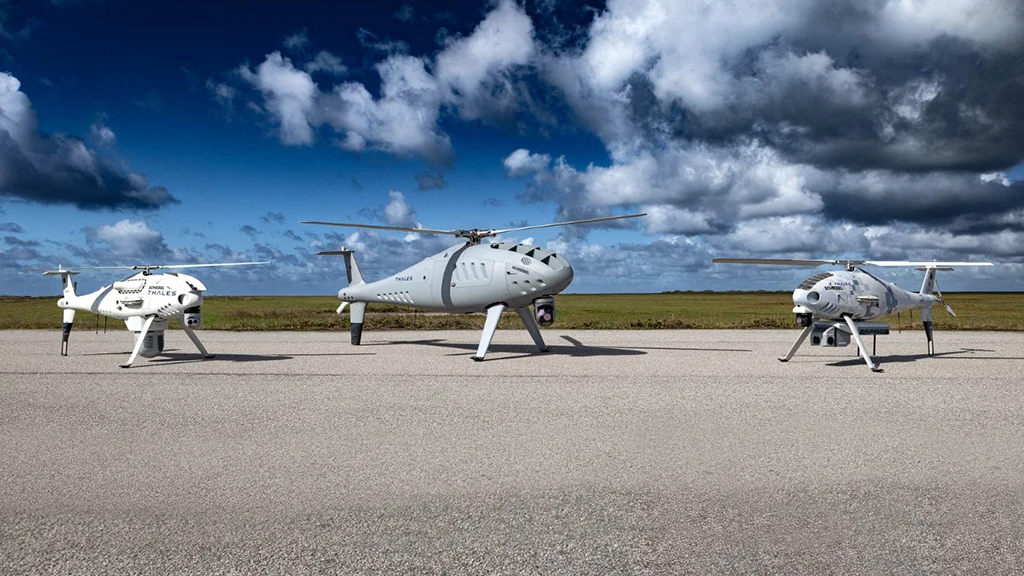
The Camcopter S-300, centre, flanked by two Camcopter S-100s.
© Schiebel
With a payload capacity of up to 350kg and 24 hours’ endurance with a 50kg payload, the S-300 represents a change in scale for Schiebel. The S-300 is aimed in particular at maritime missions, including intelligence, surveillance and reconnaissance (ISR), anti-submarine warfare (ASW) and logistical support.
Following the Camcopter S-100, Schiebel has expanded its range with a remotely piloted helicopter (RPH) designed for longer and more complex missions. “With its performance, folding three-blade rotor, engine running on the same fuel as shipborne helicopters, and reduced maintenance requirements that call for no specialised equipment, the Camcopter S-300 is ideally suited to shipboard operations. It meets growing customer demand for a system that combines greater endurance, increased payload capacity and enhanced mission flexibility,” explains Lubos Sramek, CEO of Schiebel Aéronaval SAS, based in the Var department of southern France.
On a six-hour mission, the S-300 can carry a payload of up to 250kg, allowing several systems to be accommodated on the same platform. These include electro-optical and infrared (EO/IR) systems, maritime or synthetic aperture radar (SAR), LOS and SATCOM communications relays, electronic warfare systems (ELINT, COMINT), sonobuoy launchers, magnetic anomaly detector (MAD), lidar, AIS and IFF systems, among others. This versatility expands its mission capabilities well beyond ISR to include anti-submarine warfare, multi-sensor maritime operations and cargo transport.
Changes in anti-submarine warfare
“Until recently, dozens of submarines roamed the seas, pursued by dozens of helicopters. But the seas are beginning to be overrun by thousands of uncrewed underwater vehicles (UUVs), and manned assets will not be able to keep pace. This task will increasingly fall to remotely piloted systems. With our partners, notably Thales and Naval Group, we see the Camcopter S-300 as a full-fledged anti-submarine warfare asset in its own right. Among other equipment, it can carry an ASW radar, an MAD system and eight large sonobuoys, together with their signal relays, as well as other ASW equipment,” says Sramek. “The S-300 will enhance the ASW capabilities of the ships already equipped for this mission. In addition, Schiebel, a pioneer in manned-unmanned teaming (MUM-T), is working on ASW concepts combining manned helicopters with the S-300,” he adds.
The S-300 is a key component of the SEACURE project, led by Thales and funded by the European Defence Fund (EDF). The project aims to develop and validate at sea an integrated system of unmanned platforms for joint anti-submarine warfare and seabed warfare operations, with the goal of protecting critical maritime infrastructure.
Multi-mission platform
In the maritime domain, as in other environments, the S-300 can undertake a wide range of missions, including ISR, maritime surveillance, electronic warfare, anti-submarine warfare, search and rescue (SAR), and at-sea replenishment.
“The Camcopter S-300 can be reconfigured very easily between different missions: changing the payload takes just 15 minutes. Less than an hour after completing an ASW mission, for example, the S-300 can take off again carrying a sling load for delivery to another ship. If necessary, it can even switch missions in flight to support SAR operations,” notes Sramek. The S-300 can therefore complement manned assets across a wide range of missions, preserving crews and extending service potential.
Shared architecture
Like the S-100, the S-300 is designed to operate from surface ships without dedicated launch or recovery equipment, and can be deployed from frigates or ocean-going patrol vessels. “Customers can use the same control station for both systems. This reduces training requirements, simplifies logistics and increases operational flexibility,” Sramek observes. “The S-300 also features a satellite data link, extending its operational reach both over long distances and during low-altitude flight. This capability will also be incorporated into the S-100.”
The result is a platform designed not for a single operational role, but for a wide range of missions, from maritime surveillance and anti-submarine or counter-UAS operations to logistics. This positioning reflects the evolving role of drones in naval architectures, where persistence and versatility are becoming increasingly important.
- Linda Verhaeghe


